

pre:Invent 2025 - Why Kiro is so important for AWS
Why Kiro is so important for AWS
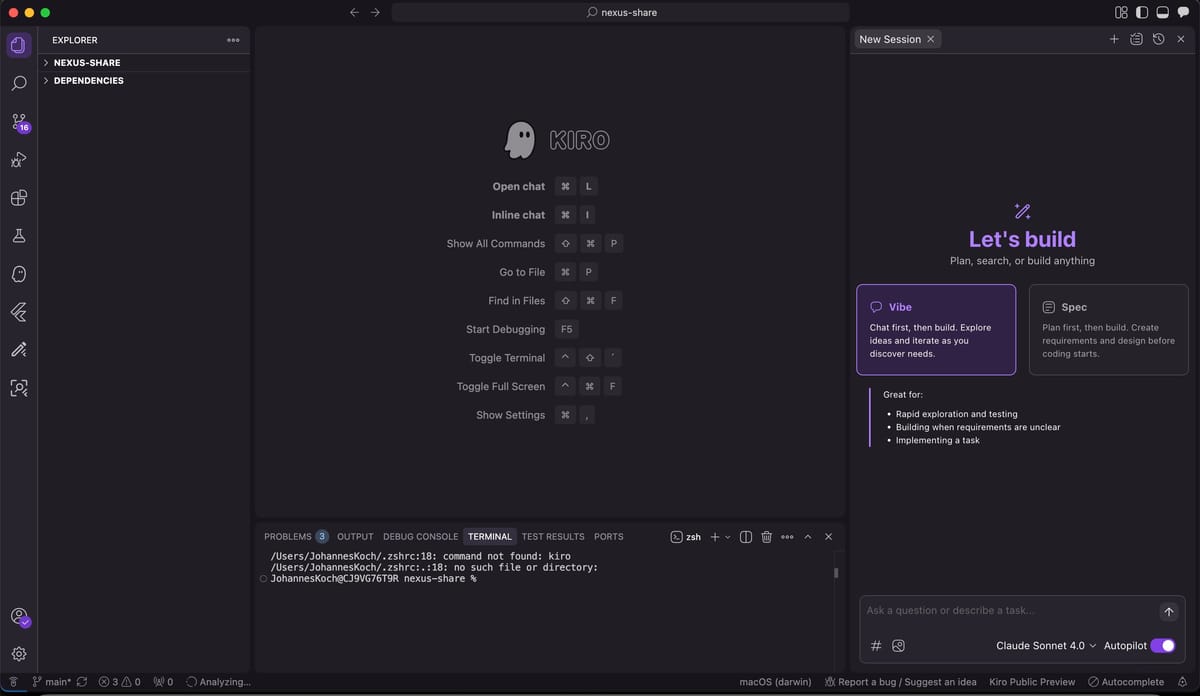
As you might have seen I have been playing around with Kiro, the Agentic IDE that AWS has announced earlier this year. You may wonder why the whole branding of Kiro is not AWS related and you might also wonder why AWS is investing building it’s own IDE. In this post I’m sharing my perspectives.
AWS & DevTools - AWS & Developers - a difficult relationship
Initially, when AWS started, it was focused on developers - builders, that wanted to be succesfful creating applications as fast as possible, aiming to showcase “cool stuff” that they built to their managers. Developers building on AWS where “the cool kids” and their career was future proof.
This relationship has cooled down a bit and other players like Vercel are the “developer friendly” platforms as they enable developers to quickly ship stuff.
AWS Developer Tools (DevTools) like CodePipeline, CodeBuild, CodeCommit (yes, it’s back!), CodeArtifact are more loved by Enterprises than by the “cool kids” that are building the future of our industry. We all know the CodeCommit story, which also didn’t make a good impression on developers that bet on it before - when AWS finally corrected the mistake of deprecating it, hours and months, potentially years of effort around the globe were spend to “find possibilities to move to an alternative”. Now, organizations can continue building on CodeCommit, which is a good thing.
And let’s not talk about AWS’ attempts to attract developers with CodeCatalyst and “Q in Github” or “Q in Gitlab”. Good ideas with a lot of potential, but unfortunately the investment into it seemed to not be able to compete with other players on the market.
With “Q Developer” (aka a more mature version of CodeWhisperer) AWS made a step into the right direction, going into the IDEs and starting back again to get talking to developers building on AWS. But the branding of “Q Developer” made it difficult and hard to understand, so once again, it was more “loved” in the enterprise world, especially as it gives access to modern models through Bedrock and the usage fees are reasonable. Although there are (undocumented) limits for it’s usage, it is possible to use it and develop cool stuff with it.
And then there is Kiro
Kiro, when I first got introduced to it, promised a lot. I’ve already written about my view on Kiro itself a while ago.
Kiro is “hip”, Kiro is cool, it has the nice ghost and it has started to attract a different type of developers and builders to the ecosystem.
Kiro has create a community of interested folkds that were previously playing around with Cursor, Claude Code, Gemini CLI and other alternatives. Going first with the “Spec based” development changed the tone in building applications with Agentic AI IDEs. Others needed to pivit and implement the same things within their tools.
Kiro allows developers to build anything, and even tho (just exactly because) it’s by definition and interest currently not branded and attached to AWS, developers seem to be keen to get their hands on it and build “cool stuff” with it.
And this is a big chance for AWS, that I hope AWS will not miss: Getting back into the hearts of builders around the world, showing them that you can build cool things easily.
And if that doesn’t happen? Then AWS might have lost the battle for the hearts of the developers and potentially also the trust of developers in AWS’ capabilities to build DevTools.
What I think Kiro needs to be successful
AWS is betting on Kiro to ensure that developers continue to be interested in working with AWS. Kiro has a lot of promises and attracted developers that previously have not been attached it AWS technology or AWS at all. A lot of very good people and friends that I know inside AWS have been working on Kiro the whole year and you will see a lot of them at re:Invent on stage. Clare Ligouri will share the keynote stage with Werner Vogels on Thursday and I can only guess that she will talk about Kiro and Strands.
AWS is all about agentic AI this year and you’ll see a lot of different use case materialize - but Kiro has been built on AI agents from the ground up and you can see that when you work with it.
Deepak is nowadays leading AWS’ agentic AI division that includes Kiro, Kiro CLI and other things - he has a proven record of being successful and his complete team seems to be working on Kiro. The chances to fail are there, but I am sure that Deepak & team will do everything they can do avoid that.
What I still hope is coming to Kiro
I would love “AWS” to come to Kiro. Ensure that Kiro becomes the best IDE to develop for AWS. Integrating other AWS extensions and capabilities - direct integation to CodeBuild / CodePipeline, advanced AWS knowledge coming from the AWS best practices and documentation, guidance on when to do what, … templates to build specific use cases on AWS. Kiro needs to empower developers to do and build things without even thinking about it while still staying as close as possible to the “infrastructure building blocks” that AWS offers and that gives developers so much flexibility to build cool things on AWS.
In addition to that, I would love to see a version of Kiro that runs in the Web and can work similar to “Ona” - offloading the agent’s work to the cloud and with that giving me the possibility to parallize even more what I do with coding agents. Having Kiro available in the web would also allow me to switch devices in the same way that Dev Environments in CodeCatalyst (Cloud9) allowed to do that a few years ago.
Let’s see what re:invent 2025 brings to Kiro - besides the “House of Kiro” and other fun stuff!
What do you think? How much influence does Kiro have on AWS’s success?